
When Students Know What Writers Do
How co-teaching and the L³IFT framework changed writing for Jenny, Megan, and their students
Jennifer “Jenny” Sprenger has taught second grade for 18 years. Megan Merkel has been a multilingual learner teacher for five. After several years of gradually building their co-teaching partnership, they spent this past school year teaching writing together in Jenny’s classroom.
They did not begin with a classroom full of eager writers. Jenny is honest about that. Writing had become the part of the day when students lost interest, shut down, or struggled to begin. She was frustrated, too. Her preparation had not shown her how to teach writing in a way that made sense to her students, and the familiar pattern of a short mini-lesson followed by “Now you go do it” was not working.
What happened next is worth paying attention to, especially for teachers who have watched students stare at a blank page and wondered what support is missing.
Jenny and Megan shared their experience at the CESA 2 ML Summit, hosted by the Sun Prairie Area School District in June. The room was packed with educators who wanted to understand what they had changed and why it worked. Jenny and Megan did not present a perfectly packaged success story. They shared where they started, what they tried, what did not work the first time, and what they learned alongside their students. This is their story.
They Made Writing Visible
Working together, Jenny and Megan used the L³IFT framework and the Teaching and Learning Cycle to slow the process down. Before asking students to write independently, they built knowledge about the topic and the genre. Students read and listened to engaging texts, talked about why authors wrote them, examined how the texts were organized, and noticed the language writers used. Then the class constructed texts together before students tried the work on their own.
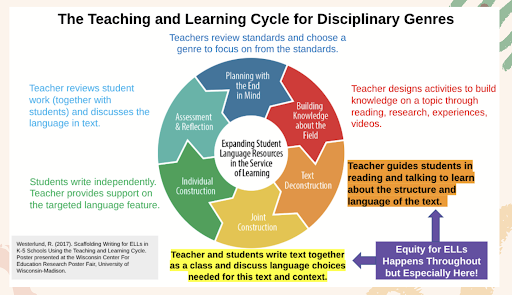
The change was not a clever prompt or a new graphic organizer. Students were learning what a narrative, an informational text, or an argument actually does. They had shared language for the parts of a text and concrete examples they could return to. Jenny and Megan also used consistent colors to mark the orientation, details, and conclusion. The colors were simple, but the thinking behind them was not.
The second graders were ready for that thinking. When Jenny introduced words such as orientation, sequence of events, and conclusion, they did not find the vocabulary too difficult. They thought using “fourth-grade words” in second grade was exciting. As Megan put it, when we teach students the language, “they learn it, and they love learning.”
The Blank Page Stopped Feeling So Blank
One of the most striking moments in Jenny and Megan’s presentation comes when Jenny describes what happened at the independent writing stage: students picked up their pencils and wrote. They did not need an adult beside them generating every idea or prompting every sentence. By the end of the year, students could write for two class periods, mostly without talking, because they understood what they were trying to create.
That helped Jenny reinterpret the shutdowns she had seen before. The students were not out of ideas. As she said, “Second graders have plenty of ideas. We learned that.” What they had lacked was enough knowledge of the genre and the language needed to put those ideas on paper.
Their pieces were still second-grade writing. There were misspellings and uneven sentences. Jenny regularly reminded students, “It’s not a spelling test. Try your best. Get your ideas.” But the students sustained a story across pages, introduced a problem, moved events forward, included details, and brought the narrative to an ending. They were becoming writers, not simply completing a writing assignment.
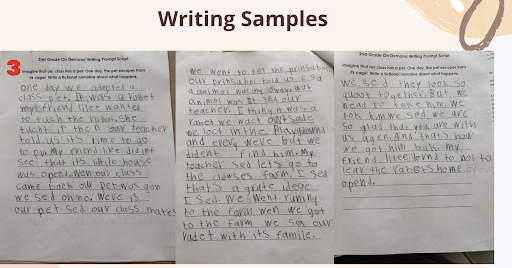
Writing Sample from a 2nd Grader who was a Newcomer in Kindergarten from Guatemala
Co-Teaching Changed the Experience for Teachers, Too
This story is also about what became possible when Jenny and Megan shared the work. They planned together, taught together, split the class into smaller groups for joint construction, and looked at student writing together. Instead of Jenny taking a stack of papers home and scoring them alone, students often sat beside both teachers, read their writing aloud, and helped identify what was present and what still needed work.
The criteria became useful, not just something printed on a rubric. Students knew what the teachers were looking for. Jenny and Megan knew what to reteach. If the class needed more work with conclusions, they could pause for a short focused unit. If a student was ready for dialogue or a more complex language feature, they could move that student forward.
There were imperfect moments. The first attempt at joint construction with the whole fourth-grade class had, in Megan’s words, “a lot of cooks in the kitchen.” Students had so many ideas that the lesson became unwieldy. The teachers adjusted, divided the class into two groups, and tried again. That kind of responsive problem-solving is part of the story, too. The framework gave them a shared direction without requiring every lesson to go exactly as planned.
The Learning Was Generative
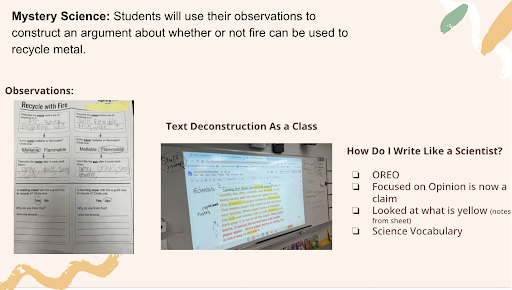
Perhaps the clearest sign of success was that students began using what they knew outside the writing block. They used text structure to identify central ideas and authors’ purposes while reading. During science, they drew on the structure of an argument to write a claim about whether fire can be used to recycle metal. Jenny did not need to start over. She could simply say, “Remember when we did this in writing? Now we’re doing it in science.”
Students began noticing those patterns on their own. They recognized that writers use structures for a reason, whether they are telling a story, explaining an idea, or making a scientific claim. Writing was no longer an isolated part of the day.
What Megan Noticed in the ACCESS Data
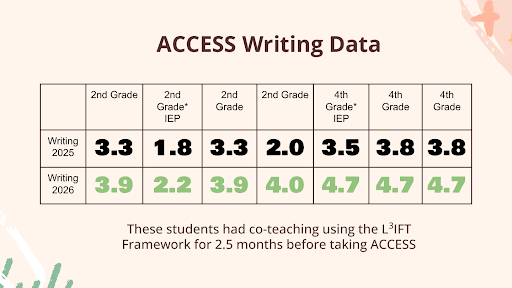
Megan pointed out that the students had received co-teaching with the L³IFT framework for two and a half months before taking ACCESS. She then highlighted what stood out to her: “In the second-grade and the fourth-grade co-taught classes, writing for the first time ever was not the lowest domain for any kids. Reading was lower for them, or even speaking. It was really exciting to see.” Megan added, “Every fourth grader exited this year,” and said the second-grade students were “very much on track to be exiting very soon.”
What Jenny Saw in the Data
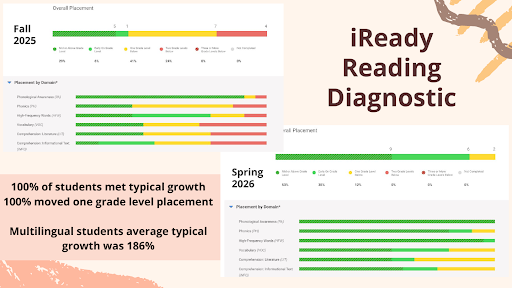
Jenny described what she saw in her classroom this way: “This definitely supported my whole group.” She described a class with reading levels spanning “from kindergarten to about third or fourth.” Looking at the i-Ready data, Jenny said, “We had 100% of our students meet their typical growth in i-Ready, and we had every student move one full grade level.”
She continued, “When you’re looking at the ML students, when you take their average typical growth, it was 186% growth for those students.” Jenny noted that this was the first year they had used this approach. “To be able to get 100% of typical growth and then 100% to improve a whole grade level,” she said, “was really exciting.”
Come Learn With Us
Jenny and Megan’s work did not happen overnight. Their co-teaching partnership developed over several years, and they continued to revise their approach as they learned. That makes their story useful. It shows what can happen when classroom and multilingual learner teachers have a shared framework, time to plan, and a clear way to connect content, language, reading, and writing.
At the L³IFT Institute on August 13 and 14 in Waunakee, educators will have time to study the framework, work with real examples, and begin applying the approach to their own students and curriculum. If you want writing instruction to feel clearer for teachers and more possible for students, we hope you will join us.
Watch Jenny and Megan’s video and explore their presentation below to hear the full story in their own words.
