Writing in a Formal Tone
In a 6th-grade classroom, students are learning how to write persuasive essays. Their uncoached writing shows that students write the way they speak. They produce sentences like:
…A phone is a very fun thing but for it to not affect your eyes you just don’t sit on it for a very long time. And the more you sit on it the more it gets addicting. You can use your phone as a tool, for example, you can do math or search something if you want to find out like a fact… you can watch movies… you can also listen to music…
As shown in the example above, one of the most common features of spoken-like informal tone is overusing the word “you.” In academic writing, “you” can sound overly personal and can assume the reader’s actions or thinking, even when students are making strong claims. Helping students recognize and revise this habit is a small shift that can have a big impact on the formality of their writing.
However, teaching students how to make choices about when and how to include the audience through the use of “you” is crucial - so that they can make strategic choices because eliminating “you” in every instance is not the point. Students need opportunities to use it strategically—such as:
In moments when directly addressing the reader is intentional and serves a specific purpose, such as motivating the reader to act. For example,
You can make a change by addressing this concern with your classmates.
In this case, the writer is speaking directly to the reader.When “you” is appropriate when the audience is known and named, such as classmates, teachers, or community members.
As students, you have the power to create a positive online environment.
In this case, the writer is intentionally building a connection with the audience, not trying to sound distant or objective.
Since this blog is on creating a formal tone, we will provide two linguistic strategies for removing the “you.” We recommend creating lessons where the focus is on teaching students when to include the “you” and when not to. It deserves special attention so that students can become informed choice makers.

Why remove “you?”
In academic writing—arguments, explanations, reports—using “you” can sound too casual and personal. It assumes what the reader thinks or does. Removing “you” helps to:
sound objective
focus on ideas, not personal behavior
shift from advice (“you should…”) to analysis (“overuse leads to…”)
What are some linguistic strategies for removing the “you?”
Some strategies to implement and show students are:
Replace “you” with a group noun: people, users, teens, individuals
Replace with passive voice: “You can see…” → “It can be seen…”
Use nominalization to remove the person entirely. Nominalization refers to the process of turning a verb, adjective, or other word or phrase into a noun.
Examples
Example Sentence: When you use your phone too long, it can hurt your eyes.
Formal Tone Change: Excessive phone use can cause eye strain.
Linguistic Strategy Implemented: Nominalization
Example Sentence: When you watch movies on the bus, it can be fun.
Formal Tone Change: When students watch movies on the bus, it can provide entertainment.
Linguistic Strategy Implemented: Use of a general noun to refer to a group of people
Example Sentence: If you keep your phone with you all day, it may make you distracted.
Formal Tone Change: Constant phone access may lead to distraction.
Linguistic Strategy Implemented: Nominalization

Explicit Instruction Activities
Deconstruction:
Cut up sentence strips with two sets of sentences: spoken-like sentences and their written-like (formal) versions. Put those in ziplock bags and give them to students. Students can do this work in pairs or in triads. Ask students to match the sentences first, and then discuss or underline the changes they notice. Ask them to find nominalization or replacing you with a general noun to refer to a group of people. Then debrief this activity by calling on students to share their observations.
Original Sentence (with “you”): When you look at your phone too much, you can hurt your eyes.
Nominalized Version (no “you”): Excessive phone use can cause eye strain.
Original Sentence (with “you”): You can use your phone to check facts quickly.
Nominalized Version (no “you”): Phones allow for quick fact-checking.
Original Sentence (with “you”): If you keep your phone with you all day, you might waste time.
Nominalized Version (no “you”): Constant phone access can lead to time-wasting habits.
Original Sentence (with “you”): When you watch videos, you get distracted from homework.
Nominalized Version (no “you”): When students watch videos, it can cause a distraction from homework.
Joint Construction:
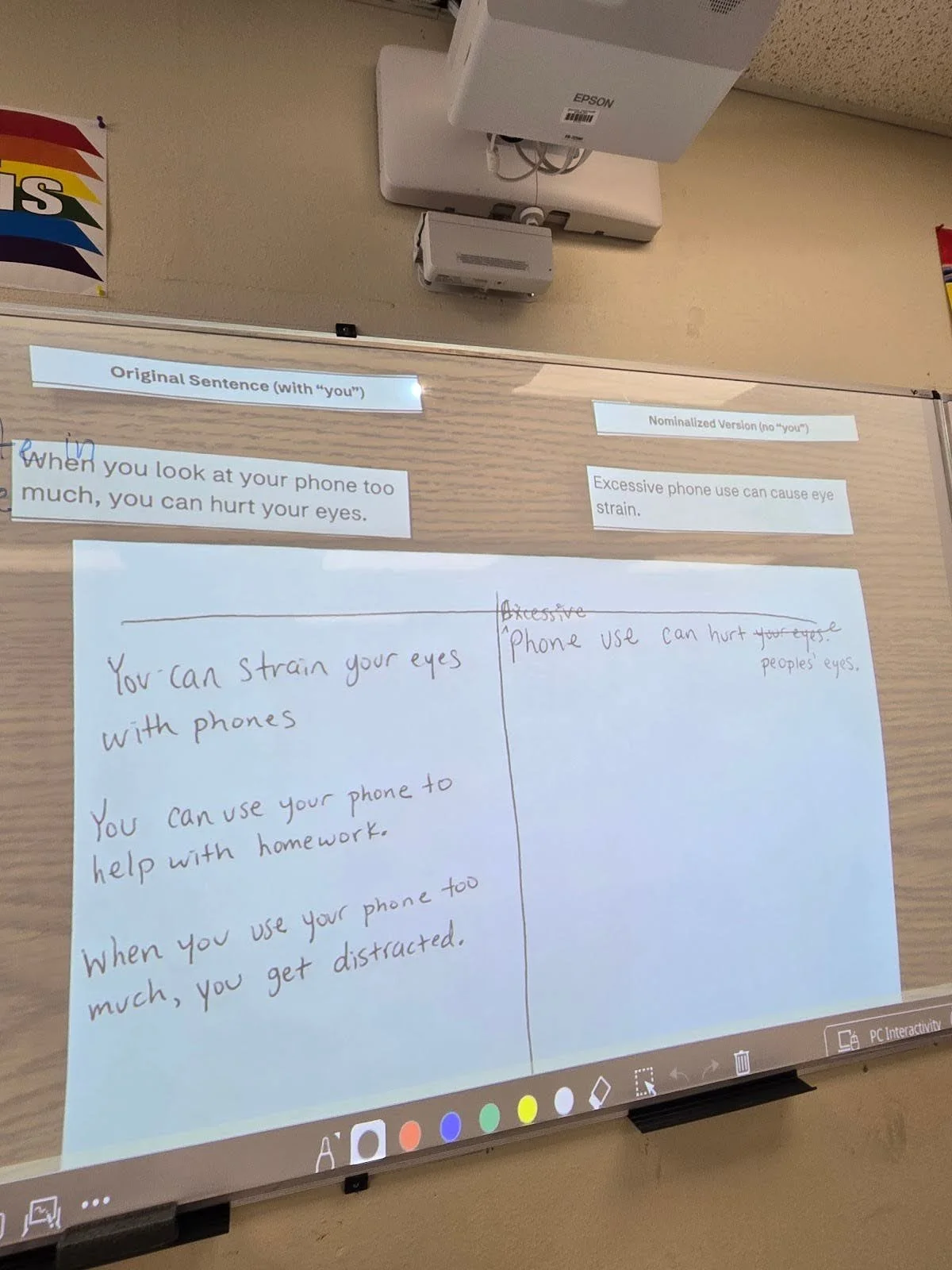
Create a T-chart and provide spoken-like sentences in the left column. Together with the class, referencing the anchor chart created during Deconstruction, students revise spoken-like sentences into formal ones. The teacher guides this process until students’ oral contributions show that they understood how to do it independently.
Independent Construction:
During independent construction, continue to revise their spoken-like sentences into written-like the way it was modeled during Joint Construction.
Original Sentence (with “you”): You can strain your eyes with your phone.
Nominalized Version (no “you”): Excessive phone use can hurt people’s eyes.
Original Sentence (with “you”): You can cause eye damage with your phone.
Nominalized Version (no “you”): Excessive phone use can damage people’s eyes.
Original Sentence (with “you”): You can use your phone to help with your homework.
Nominalized Version (no “you”): Phone use can help people with homework.
Original Sentence (with “you”): When you use your phone too much, you get distracted.
Nominalized Version (no “you”): Mobile devices cause distraction due to excessive phone use.
In Summary
Removing “you” helps students shift from casual, personal language to a more formal and academic tone. By turning actions into nouns, writers can focus on ideas rather than individuals, make their writing more precise, and strengthen arguments, explanations, and reports. With explicit modeling and practice, this strategy becomes a practical tool students can use to revise their writing across content areas.
Looking for a trackable way to ensure students are writing with a formal tone? Download our checklist, available for free!