An essential component of the L³IFT Framework is culturally sustaining practices. This begins with knowing students and intentionally creating opportunities for them to bring their full identities into learning. Translanguaging is one powerful way to do this.
Translanguaging can be understood through two key ideas: translanguaging spaces and translanguaging pedagogy.
Translanguaging Spaces
Translanguaging spaces begin with teachers taking a translanguaging stance—teachers’ beliefs that all students have a holistic language repertoire and bring this into the classroom. Teachers can invite students' languages into the classroom by:
displaying worlds and symbols of languages across the room
adding multilingual books
introducing words and phrases from languages the teachers or the students know into the space
Sharing their own language learning journeys.
Asking questions that build a sense of curiosity
Inviting students to share how words and ideas may be connected
Offering noticings: such as similarities and differences in pronunciations, or highlight how languages reflect cultures. For example, the Japanese language doesn’t emphasize “I”, or the German language, word order always matters, while in Spanish it does not.
The goal isn’t always to know or be able to communicate in all the languages that the students speak but to invite students on a journey that helps them understand that their language and understanding are valued.
Translation vs. Translanguaging
Translation and Translation are not the same. Translation transfers meaning between languages; translanguaging builds meaning through the flexible, integrated use of all language resources. Students work together and support each other using all the languages they know (Kibler et al., 2020; García & Kleyn, 2016). Students can better explain ideas, clarify thinking, and solve problems in ways that feel natural to them. Teachers can better support students by providing environments that nurture translanguaging, more so than direct translating.
Translanguaging Pedagogy
Translanguaging pedagogy goes one step further, it involves the explicit and intentional planning around students' use of their whole linguistic repertoire in order to build connections and demonstrate the understanding to a specific audience within one language or another. It is not serendipitous. The purpose goes beyond support in the moment to a connection to key language and learning outcomes.
Message Abundancy: Teachers provide the same message in multiple ways: spoken, written on the board, graphic, everyday language and technical (message abundancy) and offer multiple means of representation including Home languages.
Meta-Awareness: Teachers provide opportunities for students to build their meta-awareness of language and links across languages through explicit connections (e.g. cognate chart, text structures, root-words and language patterns.)
As part of instruction, teachers promote comprehensible input and sense making by frequently referencing word walls, repetition, Total Physical Response (TPR), cuing, language practice - choral/echo reading, songs etc.
Cognates Walls
In this 2nd grade classroom, students were first asked to read the story independently or in pairs in their own language, then working in groups to identify words that were central to the story. In table groups, students then identified the words that were cognates and added these to the cognate wall. The cognate chart was referenced throughout the unit. As an end product, students wrote summaries of the stories.
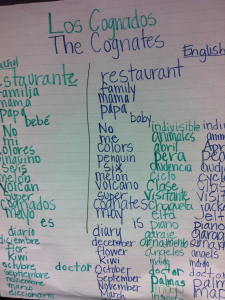
Cognates/Cognados Wall Chart
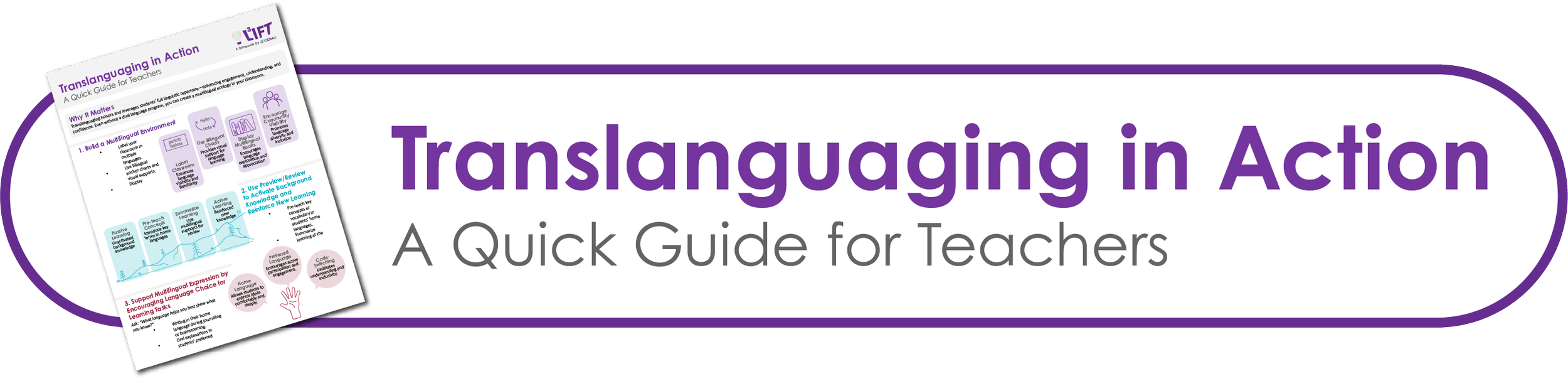
Looking for more guidance on translanguaging? Download our quick guide for teachers in small districts through the form below!