
Making The Language of Explanations Visible: A 4th Grade Unit on How Recycling Works
In a fourth-grade classroom in Cashton School District in Wisconsin, Ms. Christopherson and her class of 4th-grade multilingual learners are exploring the process of recycling through the genre of sequential explanations. The unit was designed using the L3IFT Framework and principles from Systemic Functional Linguistics (SFL) to explicitly teach the language students need to explain processes.
Below is a walkthrough of how the unit unfolds and how teachers can adapt this approach in their own classrooms.
What Are Sequential Explanations?
Sequential Explanations are in the genre family of Explanations (Key Language Use Explain). They are the genres for explaining “How” or “Why” of a phenomenon. The purpose of Sequential Explanations is to explain a process. Unlike causal explanations, they do not include an element of causality because their purpose is not to explain what causes what to happen but to explain how a process goes through steps in a linear sequence (Derewianka & Jones, 2023). Some examples are how honey is made, how paper is made, how a bill becomes a law, how recycling works, and many others. Sequential Explanations are prevalent in science and social studies because those disciplines are concerned with various processes in the engineering, social, economic, and political spheres.
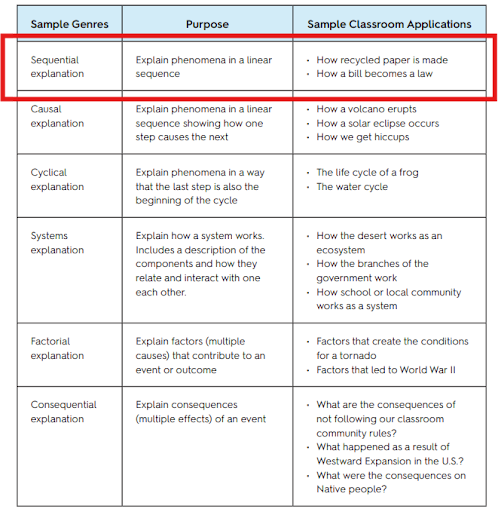
Figure 1. Explain Genre Family (WIDA, 2020, p. 228).
Why Teach Explanations Explicitly?
Many students struggle with explanations because teachers focus on teaching the content of explanations (recycling, magnetism, electricity) but not the language features students need for the explanations. The WIDA ELD Standard 4: Language for Science ELD-SC.4-5.Explain.Expressive expects that students can construct scientific explanations that describe phenomena and establish a neutral and objective tone (WIDA, 2020, p. 122).
How do we describe a process?
How do we establish a neutral tone?
Let’s take a look at how Ms. Christopherson taught those language features explicitly. She used the Teaching and Learning Cycle to teach language explicitly.
Step 1a: Build Knowledge Through Multimodal Learning and Class Talk
Before writing begins, students first build knowledge about recycling.
The unit starts with:
A video about recycling
A visual infographic showing the recycling process
Short structured discussions
These multimodal supports are critical for multilingual learners because they provide message abundancy—multiple ways to access meaning.
Students learn recycling is a sequential explanation consisting of a series of steps:
Collection
Transportation
Sorting
Processing
New products
The science content provides a meaningful context for learning the explanation genre.
Step 1b: Guided Oral Practice
Before students write explanations, they first practice explaining orally.
Students use structured conversation frames such as:
“Can you explain the process of recycling a plastic water bottle?”
“At first… Then… Finally…”
These discussions help students rehearse the sequential language patterns of explanation beyond first, next, and finally.
This stage is essential because:
Students often need to say ideas before they can write them.
Step 2: Study the Structure of an Explanation
Students then learn the organizational structure of a sequential explanation. The teacher shows that the Explanation genre consists of two stages: Phenomenon Statement and Explanation Sequence. Conclusion is often optional in Explanations. The Explanation Sequence in this topic includes phases of the steps in the recycling process: Collection, Transportation, Sorting, Processing, New Products.
—-
Recycling Example
Recycling is a process of many steps. The process starts when used materials like plastic bottles, paper, and glass jars are collected from homes, schools, and businesses. These recyclable items are placed in special recycling bins instead of the regular trash.
After that, the recycling truck picks up the bins and takes them to a large recycling center. At the recycling center, the collected items are hand-checked and sorted into different groups (plastic, paper, metal, glass) using a trommel. A trommel is a large perforated spinning drum that separates the materials. This sorting is necessary because each type of material needs to be recycled in a different way.
Then, the clean, sorted materials are sent to factories. In these factories, the materials are cleaned with a chemical solution and processed. For example, plastic bottles are melted down and turned into small plastic pellets or shreds. These new shreds are used to make new products, such as recycled water bottles or clothes.
As a result, recycling reduces the amount of waste that goes into landfills. Because of recycling, we save natural resources that keep the earth and ecosystems cleaner for future generations.
—-
To learn the stages and phases of How Paper is Recycled, students cut up the text, put it together, and discuss the order. They notice that the order is linear and cannot be messed around with because it represents the process of how plastic is picked up at your home and ends up as new material.
Stage 1. General Statement of Phenomenon
Example: Recycling is a process of many steps.
Stage 2. Explanations Sequence
Collection
Example: Materials are collected…Transportation
Example: Materials are transported…Sorting
Example: Materials are sorted, separated, and cleaned…Processing & New Products
Example: Materials are processed and transformed into new products…
Stage 3. Conclusion - How It Contributes to a Cleaner Planet
Example: As a result, recycling reduces waste…and keep the earth cleaner for future generations.
Step 3: Deconstruct the Mentor Text for Language Features
Next, the class analyzes a model explanation text titled “The Recycling Journey.”
The teacher guides students to examine how language works in text.
They identify key language features such as:
Language Feature
Noun groups
Example: used materials like plastic bottlesVerb groups in passive voice
Example: are collected, sorted, processedLanguage of time
Example: after that, thenLanguage of place
Example: at the recycling centerDefinitions
Example: A trommel is a large perforated drum
This analysis helps students notice that explanations are not only about content but that they are realized through specific language features.
Students begin to understand that writers make meaning through language choices to meet the genre expectations.
The teacher and students jointly construct an anchor chart like this:
Noun Groups: Let’s find together noun groups that tell us the objects for recycling or the equipment,
Verb Groups: Let’s find together verb groups that tell what happens to the materials.
Language of Place: Can you identify phrases that describe where steps in the recycling process happen?
Language of Time: Can you identify phrases that indicate when steps in the recycling process take place?
-
used materials like plastic bottles,
paper and glass jars
large perforated spinning drum
amount of waste,
Landfills
small plastic pellets or shreds
natural resources,
the clean, sorted materials
new products, water bottles or clothes
-
are collected,
are placed,
are sent,
are cleaned, separated, and sorted
are melted down,
are turned into
are hand-checked
-
from homes, schools and businesses;
in special recycling bins
in these factories
to a large recycling center
at the recycling center
into landfills
into different groups
-
The process starts when used materials
After that,
When it’s done…
Step 4: Joint Construction of Text
After analyzing the mentor text, students begin writing together with the teacher.
This stage is called Joint Construction in the Teaching and Learning Cycle.
Students collaboratively:
organize the steps of recycling
construct sentences together
discuss why we need passive voice and not active
discuss how to sequence using the language of place (at the recycling center, inside the factory, at
This process helps students see how sentences are constructed for the purpose of explaining a process, not just for the sake of grammatical accuracy.
For example:
At the recycling center, the collected items are sorted because each materials must be recycled differently.
Where/When: At the recycling center
What: the collected items
What Happens: are sorted
Why: because each material must be recycled differently.
At the recycling center, the collected items are hand-checked and sorted into different groups (plastic, paper, metal, glass) using a trommel.
Where/When: At the recycling center
What: the collected items
What Happens: are hand-checked and sorted
Why: into different groups (plastic, paper, metal, glass) using a trommel.
After that, the recycling trucks pick up the bins and take them to a recycling center.
Where/When: After that,
What: the recycling truck & the bins
What Happens: pick up the bins and take them
Why: to a recycling center.
Then the clean, sorted materials are sent to factories, cleaned with a chemical solution, and processed into new products (e.g., plastic pellets, shreds).
Where/When: Then
What: the clean, sorted materials
What Happens: are sent…and cleaned with a chemical solution and processed
Why: to make new products (e.g., plastic pellets, shreds).
Step 5: Multimodal Representation
Students then create large infographic posters explaining the recycling process.
Each poster includes:
diagrams of the recycling cycle
images of recycling equipment
short explanation texts grouped and placed by the right step in the process
A student learned how to communicate scientific ideas in multiple modes.
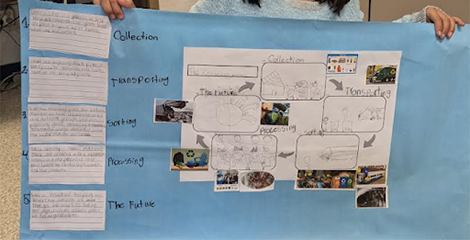
Student Poster of the Recycling Cycle
Step 6: Independent Writing
Finally, students complete the independent writing task: Explain how paper or glass are recycled. Show the process step by step.
Students use a checklist to guide their writing.
Student Checklist for Sequential Explanations
Genre Stages
Genre Stage: General Statement (Introduction)
☐ I state what the process is about.
☐ I introduce what will be explained.
Genre Stage: Explanation Sequence (Steps in the Process)
☐ I explain the steps in the process in the correct order.
☐ I use time words like first, next, then, after that, finally.
☐ I show how each step leads to the next step.
Conclusion
☐ I explain why the process matters.
☐ I show the result of the process. Example: As a result, recycling reduces waste and protects the environment.
Diagram to Show Process
☐ I include a diagram that shows the steps of the recycling process.
☐ I label each step clearly.
☐ I use arrows or numbers to show the order of the process.
Language Features
Noun Groups (Name the Things)
☐ I use clear and specific nouns.
☐ I include details in noun groups. Example: used materials like plastic bottles, paper, and glass jars
Verb Groups (Show What Happens)
☐ My verbs show what happens to the materials at each step. Example: are collected, are sorted, are processed
Language of Time (Show Order)
☐ I use time words to show the sequence. Examples: at first, then, after that, next, finally
Language of Place (Show Where Things Happen)
☐ I tell where each step happens. Examples: at the recycling center; in special recycling bins
Precise Vocabulary (Sound Like an Expert)
☐ I use precise vocabulary related to recycling. Examples: materials, sorting, trommel, plastic pellets
Why It Works
This unit works because it integrates content, language, and literacy, and it positions literacy and learning in the service of learning (L3 in L3IFT).
-
Derewianka, B., & Jones, P. (2023). Teaching language in context (3rd ed.). Oxford University Press.
WIDA. (2020). WIDA English language development standards framework, 2020 edition: Kindergarten–Grade 12. Board of Regents of the University of Wisconsin System. https://wida.wisc.edu/resources/wida-english-language-development-standards-framework-2020-edition
